AI Implementation Consultant Role in Enterprise Execution
Leadership teams may develop strong AI strategies yet still face difficulty converting those strategies into dependable operating capabilities. The challenge often becomes more complex when existing applications, legacy systems, data controls, security requirements, and business processes must remain in place while new AI capabilities are introduced.
AI Implementation Consultants can work across technology, operations, data, compliance, and leadership functions to translate strategic intent into executable architecture. Their work may include defining system boundaries, identifying required data flows, documenting dependencies, designing integration patterns, and clarifying which teams own model behavior, workflow changes, monitoring, and exception handling.
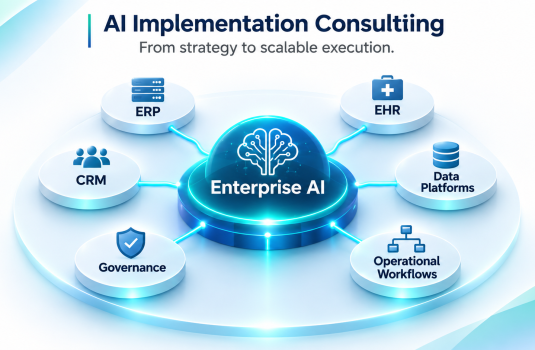
In practice, this role can help connect AI initiatives with the systems where employees already perform work. Rather than positioning AI as a separate experimental layer, implementation planning may place model outputs inside ERP, EHR, CRM, service management, analytics, or other operational environments where decisions already occur.
Strategically, this role may give executives a clearer path from AI ambition to controlled execution. It can also help leadership teams evaluate whether proposed use cases fit current infrastructure, workforce capacity, risk tolerance, and operational priorities before additional investment becomes committed.
Why AI Pilots May Stall Before Production
AI pilots can demonstrate technical potential without demonstrating operational readiness. A model may perform well in a controlled environment while the surrounding organization lacks the data quality, system integration, ownership, security, and workflow design needed for broader use.
Common breakdowns may include fragmented data pipelines, unclear decision rights, limited production monitoring, inconsistent access controls, and weak integration with the processes employees use every day. When users must leave their normal workflow to access AI output, adoption can remain limited even when the model itself appears technically sound.
Governance can become another constraint. Legal, compliance, security, risk, and business leaders may need clear answers about data usage, output review, accountability, auditability, and exception handling. AI Implementation Consultants can help surface these questions earlier and translate them into design requirements rather than treating them as late stage approval issues.
The strategic implication may extend beyond one project. A stalled or poorly governed deployment can reduce executive confidence in future AI investment. A more disciplined implementation approach may help organizations distinguish model quality problems from execution problems and protect momentum across a broader AI portfolio.
AI Implementation Roadmap From Pilot to Production
Moving from a pilot to production typically requires a sequence of operating decisions that goes beyond model development. Leadership teams may benefit from treating implementation as a staged business and technology program rather than a single deployment event.
A practical roadmap may include the following components:
- Translate pilot findings into operational requirements and user scenarios
- Define production architecture, system dependencies, and data pipelines
- Integrate AI outputs into live workflows and decision points
- Establish security, governance, ownership, and exception procedures
- Validate performance under realistic volume, latency, and failure conditions
- Define monitoring, maintenance, retraining, and escalation responsibilities
The mechanism behind this sequencing involves reducing uncertainty at each stage. Data quality questions can be addressed before workflow automation expands. Security and control expectations can be defined before broad access becomes enabled. Monitoring and ownership can be established before users depend heavily on AI supported processes.
Strategically, a roadmap can give executives greater visibility into decision points, investment requirements, dependencies, and readiness criteria. It may also make it easier to pause, redesign, or expand an initiative based on evidence rather than momentum alone.
Integrating AI Into Existing Enterprise Systems
Most organizations may not replace core platforms simply to support an AI initiative. AI implementation therefore often depends on how effectively new capabilities can coexist with ERP systems, EHR platforms, CRM applications, data warehouses, service tools, and other established technology.
Implementation consultants can design integration layers that allow models to receive the right information and return outputs without unnecessarily disrupting current operations. Depending on the use case, this may involve APIs, event based triggers, message queues, workflow orchestration, data services, or controlled batch processes.
The practical design question can involve more than connectivity. Consultants may need to determine what happens when source data becomes unavailable, an AI service times out, a model produces an uncertain output, or a downstream application cannot accept the response. Fail safe behavior, fallback procedures, and exception routing can therefore become part of production architecture.
Strategically, strong integration design may allow organizations to gain value from AI while preserving investments in existing systems. It can also reduce the pressure to pursue large platform replacements when a more targeted integration approach may support the desired business outcome.
AI Governance, Data Control, and Security Readiness
AI implementation may introduce new questions about data access, model accountability, output review, privacy, security, and regulatory exposure. These considerations can become especially important when AI interacts with sensitive financial, clinical, customer, employee, or operational information.
Implementation consultants can help translate governance expectations into technical and operational controls. This may include role based access, approved data sources, logging, human review requirements, model usage restrictions, change approval, audit evidence, and escalation procedures for unexpected behavior.
Data control can also influence model reliability. Consultants may design validation rules, data quality checks, lineage documentation, and source ownership practices so leadership teams can better understand which information feeds an AI process and how changes in that information may affect performance.
Strategically, governance readiness may support broader adoption because stakeholders can evaluate how AI operates within defined boundaries. Rather than positioning governance as an obstacle to innovation, leadership teams may use it as a framework for determining where AI can scale responsibly and where additional controls may be appropriate.
Are You Looking to Hire a Proven AI Implementation Consultant?
Helping companies discover the perfect talent for their needs. Finding the right individuals to drive your success is what we excel at.
Operational Adoption and Workflow Integration
AI can provide limited organizational value when outputs remain disconnected from the work employees perform. Adoption may depend on whether AI appears at the right point in a process, supports a recognizable decision, and fits existing accountability without adding unnecessary complexity.
AI Implementation Consultants can examine how users complete tasks today, where delays or information gaps occur, and which decisions may benefit from AI support. They may then redesign workflows so AI output reaches the appropriate user, at an appropriate time, with enough context for informed action.
Change management may also require role clarity. Employees may need to understand when AI recommendations can be used directly, when human review remains appropriate, how exceptions should be handled, and who owns final decisions. Training, communication, workflow documentation, and escalation design can support this transition.
Strategically, adoption planning may help leadership teams evaluate AI through actual operating behavior rather than deployment completion alone. Usage, exception rates, employee acceptance, workflow cycle time, and decision quality can provide more useful signals than simply confirming that a model has been placed into production.
Scalability, Monitoring, and AI Lifecycle Management
A production AI system may need to operate across changing data, business conditions, user demand, and system dependencies. Initial performance can therefore provide only part of the information leadership teams need when assessing long term viability.
Implementation consultants can design monitoring for model performance, system availability, response time, data drift, output quality, usage patterns, and exception volume. They may also help define when retraining, model review, configuration changes, or human intervention should occur.
Modular architecture can support this work by separating components such as data ingestion, model services, workflow logic, and monitoring. This approach may make individual parts easier to update, test, audit, or replace as requirements evolve.
Strategically, lifecycle management can help executives view AI as a managed operational capability rather than a one time technology project. Ongoing ownership, maintenance, monitoring, and improvement may support more predictable performance and can reduce dependence on repeated reinvention when models, vendors, or business requirements change.
Executive Metrics for AI Implementation Value
Executives may need measurement frameworks that connect AI implementation with business priorities rather than technical performance alone. Model accuracy, latency, and availability can matter, yet these indicators may not fully explain whether the initiative supports operating objectives.
Leadership teams can consider a balanced set of measures such as:
- Workflow adoption and active user participation
- Cycle time changes in AI supported processes
- Exception volume and manual intervention rates
- Operational reliability and recovery performance
- Cost, capacity, or productivity movement where relevant
- Decision quality, consistency, or response speed
- Compliance, audit, or governance indicators tied to the use case
The mechanism involves connecting technical telemetry with the operating process the AI capability supports. A model may perform well technically while adoption remains low, exception handling remains costly, or downstream teams receive little practical benefit.
Strategically, a broader measurement model may help executives compare AI initiatives, decide where additional investment could be justified, and identify where redesign may provide more value than continued technical optimization.
Securing AI Implementation Consultants for Scalable Execution
AI implementation talent may require a combination of architecture, integration, data, governance, operational, and stakeholder skills. Organizations that focus only on model development experience may overlook the capabilities needed to move AI into live enterprise environments.
Hiring teams can evaluate whether candidates have experience translating pilots into production systems, integrating AI with established platforms, designing monitoring and governance, managing cross functional dependencies, and communicating implementation tradeoffs to executive stakeholders.
Relevant experience may vary by organization. Healthcare environments may place greater emphasis on clinical workflows, privacy, interoperability, and regulated data. Accounting, finance, and other enterprise settings may prioritize control traceability, reporting integrity, security, and integration with core business systems.
The THOR Group can help organizations identify experienced AI Implementation Consultants and related technology professionals whose backgrounds may align with production deployment, enterprise integration, governance, and operational execution. Consulting, contracting, or direct hire models may give leadership teams additional flexibility when matching AI capability with project scope, internal expertise, and implementation timelines.
Strategically, specialized sourcing may help organizations focus candidate evaluation on execution readiness rather than broad AI familiarity. This can be especially useful when leadership teams need professionals who can operate across both technical architecture and organizational decision making.
Are You Looking to Hire a Proven AI Implementation Consultant?
Helping companies discover the perfect talent for their needs. Finding the right individuals to drive your success is what we excel at.
Frequently Asked Questions
What does an AI Implementation Consultant typically focus on?
An AI Implementation Consultant may focus on moving AI from strategy or pilot activity into production systems by addressing architecture, integration, data flow, workflow design, governance, monitoring, ownership, and operational adoption.
When may an organization need an AI Implementation Consultant?
Support may be useful when a pilot is ready for production, when AI initiatives remain disconnected from existing systems, when governance questions delay deployment, or when leadership needs a clearer implementation roadmap across multiple business functions.
Can AI implementation use existing enterprise infrastructure?
In many cases, existing systems can remain part of the operating environment. Consultants may design integration layers that connect AI with current ERP, EHR, CRM, data, or service platforms while managing continuity, security, and control requirements.
How can executives evaluate whether AI implementation is scaling effectively?
Executives may review adoption, workflow cycle time, exception volume, reliability, operating impact, governance performance, and measurable business outcomes in addition to model performance metrics.
Why may AI governance matter during implementation?
Governance can help define approved data use, access boundaries, review requirements, accountability, monitoring, audit evidence, and escalation procedures. These controls may support stakeholder confidence as AI usage expands.
What should hiring managers look for in an AI Implementation Consultant?
Hiring managers may consider production deployment experience, enterprise integration capability, data architecture knowledge, governance awareness, monitoring experience, workflow design, and an ability to communicate effectively across technology, operations, compliance, and executive teams.